
Implementing Semi-Open Primaries in 2026
New Mexico will use semi-open primaries for the first time in June 2026! This means that independent, unaffiliated, and Declined to State (DTS) voters will be able to participate in primary elections without having to change their voter registration.
Previously in New Mexico, such voters had to conduct same-day registration and change their party affiliation to a major party in order to be able to vote. Under the new law, signed and enacted in 2025, independent, unaffiliated, and DTS voters can request the ballot of the major party of their choosing without having to go through the same-day voter registration process.
This new law allows over 330,000 New Mexicans to participate in primary elections without added barriers. If you’re an independent, unaffiliated, or DTS voter you can now vote in primaries just as you are! Stay tuned to the NM Secretary of State and your County Clerk’s offices to learn more about the details of this new change.
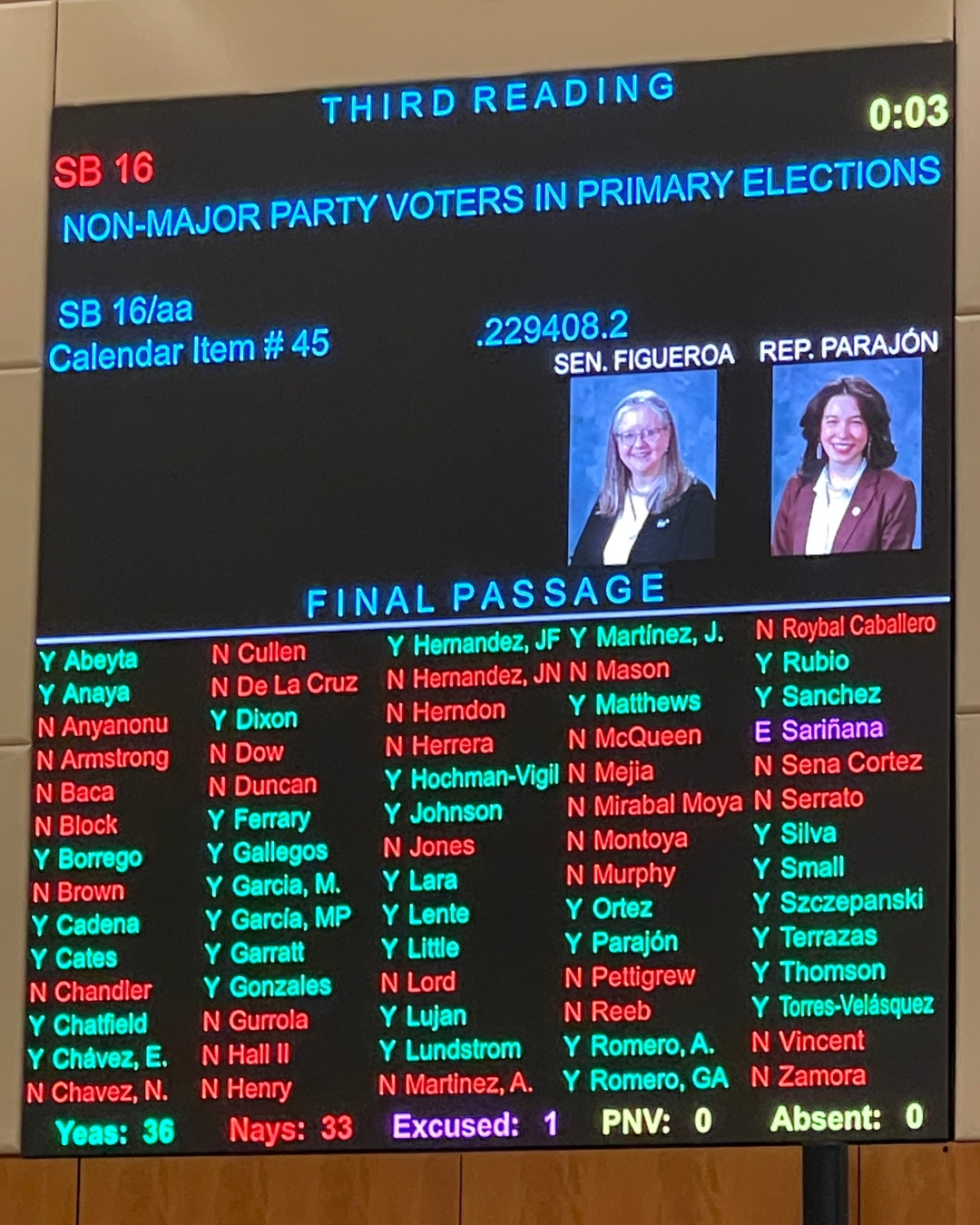
Changing New Mexico’s Primary System
History and Victory
For decades, New Mexico’s closed primary system had grown to exclude over 330,000 independent, unaffiliated, and DTS voters—nearly a quarter of the electorate—from publicly funded primary elections unless they temporarily changed their party affiliation. This burdensome process suppressed participation and led to unrepresentative outcomes in primary elections that often determine who holds office. Despite the growing number of independent voters—especially among young, Native, and Hispanic/Latino communities, and veterans—turnout remained low and voices went unheard in our democratic process.
During the 2025 legislative session, NM Voters First (NMVF) led a successful advocacy effort to change that. Partnering with our 501(c)(3) sister organization New Mexico Open Elections, and a diverse statewide coalition, we helped pass SB16, making New Mexico only the second state in the country to adopt semi-open primaries through legislation. With the support of key lawmakers, election officials, and national allies like Open Primaries and Unite America, we secured a major victory for voter inclusion. Starting in June 2026, independent, unaffiliated, and DTS voters will be able to vote in the primary of their choice. This law expands access, increases participation, and strengthens our democracy!
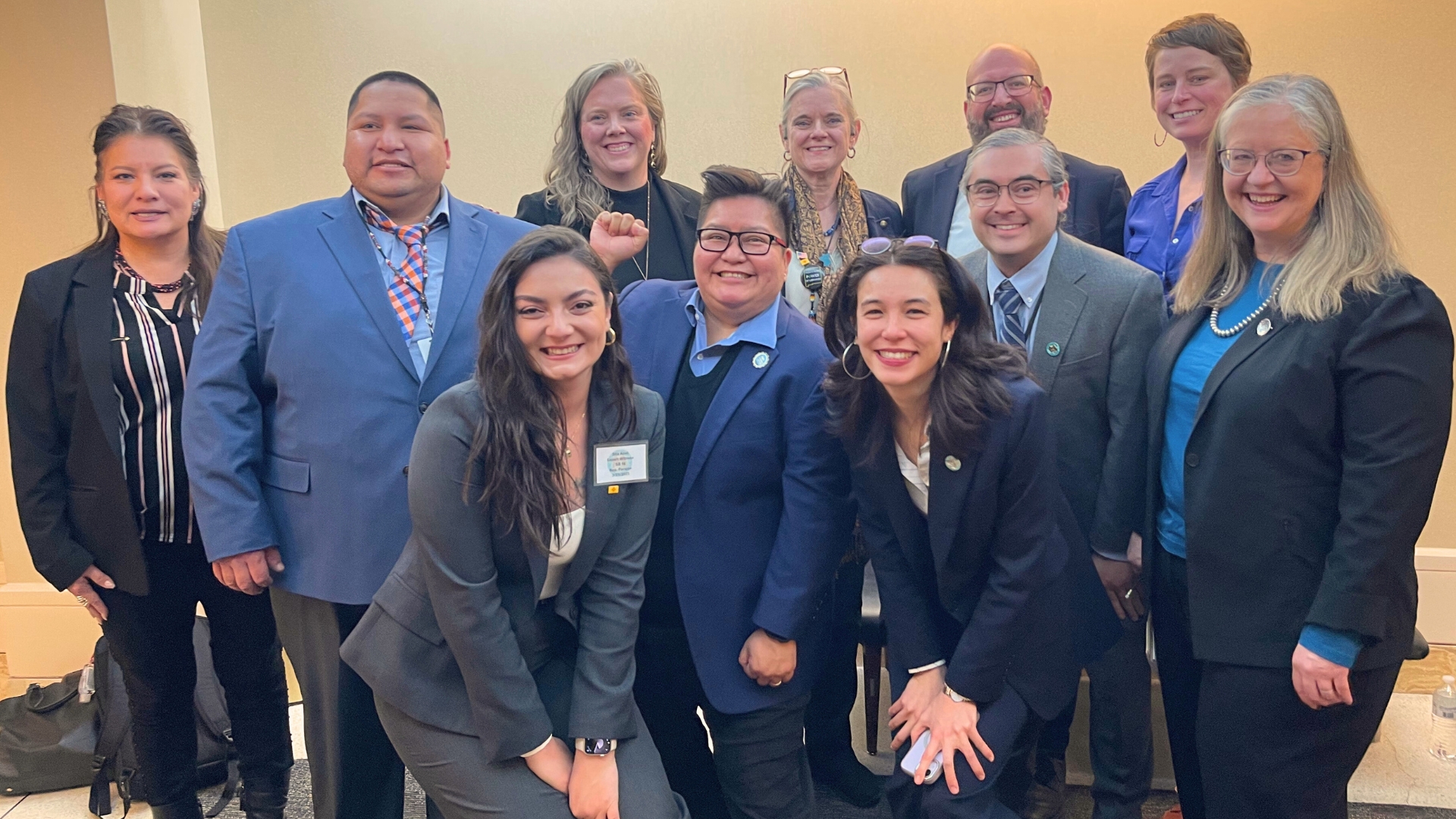
We are grateful for the coalition that made this win for inclusive democracy possible!
Common Cause New Mexico
NAACP NM
NM Native Vote
NM Asian Family Center
Conservation Voters of New Mexico
DPNM Veterans and Military Families Caucus
DPNM Environmental Justice Caucus
Veterans for All Voters
Young Democrats of New Mexico
UNM College Democrats
La Raza Unida de Neuvo Mexico
League of Women Voters of New Mexico
Lutheran Advocacy Ministry - New Mexico
Alliance for Local Economic Prosperity
Progress Now New Mexico
NM Comunidades en Acción y de Fé (NMCAFé)
Equality New Mexico
New Mexico Black Leadership Council
This coalition made the successful passage of SB16 possible, as every organization came together to work towards the inclusion of more voters in the democratic process.
Also key to passage were the incredible 2025 bill sponsors: Senate Majority Leader Peter Wirth, Senator Natalie Figueroa, Representative Kathleen Cates, Representative Angelica Rubio, Representative Parajón, and Senator Moe Maestas. We thank them for championing this effort. We also couldn’t have accomplished this win without the support of the NM House of Representatives Democratic Leadership.
We are also very thankful to our election administrators who supported this bill, the New Mexico Secretary of State Maggie Toulouse Oliver and Director of Legislative and Executive Affairs Lindsey Bachman, the Bernalillo County Board of Commissioners, Bernalillo County Clerk Michelle Kavanaugh, Santa Fe County Clerk Katharine Clark, Doña Ana County Clerk Amanda López Askin, Guadalupe County Clerk Robert Serrano III, and Sandoval County Clerk Anne Brady-Romero.
Additionally, our decade-long national partners at Open Primaries provided legal advice and helped organize independent voters to speak in favor of this bill. Another decade-long national partner, Unite America, made the execution of our strategy possible. Independent voters and our supporters, including board members of both organizations, made this victory possible.
Why Semi-Open Primaries?
Independent and DTS voters have been the fastest growing voting block in our state, but also our country. In 2006, there were merely 160,000 independent and DTS voters in New Mexico. Fast forward to 2024, there were over 330,000 registered independent and DTS voters in our state. Nationally, ⅓ of voters identify as independents and states are moving toward more inclusive, open ways of conducting primaries.
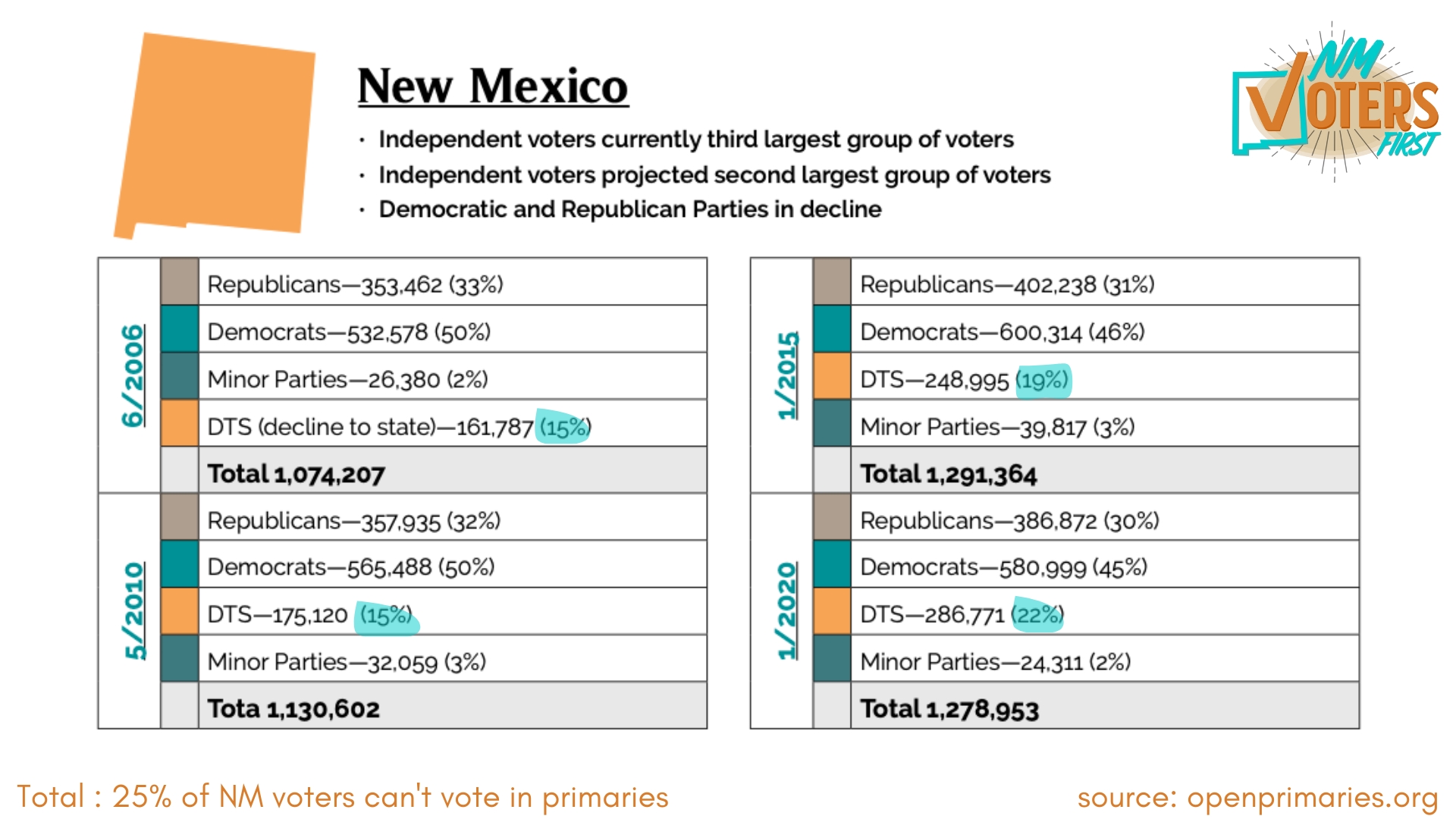
Primary elections determine 80% of all elected seats due to uncompetitive districts and elections. In 2024, New Mexico’s primary turnout was only 17%. When there is low turnout in primary elections, it means that a very small group of voters are choosing who gets to represent entire districts and even our state. We need more people participating in all elections, and as the New Mexico Secretary of State Maggie Toulouse Oliver always says, “participation begets participation”. This is why it was crucial for New Mexico to open our state’s primaries to independent and DTS voters.
With over 30 states having some form of open primaries, arguments for New Mexico to adopt this form of election included:
- Greater voter voice: In a semi-open primary, DTS/Independent voters are able to choose which major party's primary they want to participate in.
- Greater voting access: As of 2024, nearly 25% of New Mexicans registered as independents were not able to vote in our publicly-funded primary elections.
- Higher turnout: Research suggests that semi-open primary elections may lead to higher voter turnout, as more voters are able to participate in the primary process. Colorado saw an increase of 20% in their primary elections when they opened their primaries to independent voters in 2016.
- Greater influence for independents: In a semi-open primary, independent voters may have more influence on the outcome of the primary, as they are able to choose which party's primary to participate in. This can give them a greater voice in the political process.
- Decreased political polarization: Some proponents of semi-open primaries argue that candidates may need to appeal to a wider range of voters in order to win the primary. States that have opened their primaries have seen a decrease in violent extremism after making the change. Elected officials must then work on coalition-building and problem-solving to be seen as effective by the increased voting population, and can't just remain in place by pandering to a small part of their electorate.
Who are Independent/DTS voters?
Fifty-one percent of US voters now identify as Independent/DTS voters, and this affiliation is growing faster than any other party membership in the United States. In states like New Mexico, these voters, have historically not been allowed to participate in publicly-funded primary elections.
Independent voters are diverse in their beliefs and their backgrounds. Including their voices in primary elections leads to more inclusive elections. Nationwide, independent voters include:
- 49% of veterans
- 20% of Native voters, 30% of African-American voters, 40% of Asian-American voters, and 37% of Hispanic/Latino voters
- 50% of young voters
Locally in New Mexico, independent/DTS voters are:
- 35% of young voters. *Young voters (voters under the age of 35) are registered as independent more than with either major party
- 41% of young Native voters and 28% of Native voters overall
- 32% of young Hispanic/Latino voters and 42% of Hispanic/Latino voters overall
Open Primary FAQs
As we've educated the public about semi-open primaries, we've also heard a number of concerns about this change. Here are some of the most common questions people ask about this system and more information about those issues:

- Since open primaries are a new idea, how do we know they'll work in New Mexico?
As of 2024, 34 other states have some form of open primaries. Advocates in many of the closed primaries states are working towards reform, which could drastically change this map and give millions of voters a voice in primary elections.
- Won't people try to have undue influence and strategically vote against candidates in other parties?
Research has shown that this doesn't happen in a meaningful way, and open primaries may actually reduce the amount of strategic voting as compared to closed primaries. Even in a situation where there was an organized attempt at this by popular media personalities, it did not work.
- Don't political parties have the right to determine who votes for their candidates?
Because primaries are publicly-funded elections, we believe voters have the right to choose the candidates that best represent them in all elections. Furthermore, the number of independent voters are growing and currently represent the largest group of voters. 61% of young voters and 49% of veterans are independent, and we don't think they should be excluded from being represented in primary elections.
- Aren't open primaries unconstitutional?
No courts have ruled that semi-open primaries, which are going into effect in New Mexico, are unconstitutional.
- Doesn't same-day voting registration eliminate the need for any kind of open primary?
No. In talking with New Mexican voters, we've heard again and again that in reality it takes them months to switch their registration after changing it to be able to vote in a primary. This is an unfair burden for independent voters.
*Sources for data and more research is available from our partner organization Open Primaries.
Do you like this page?
